
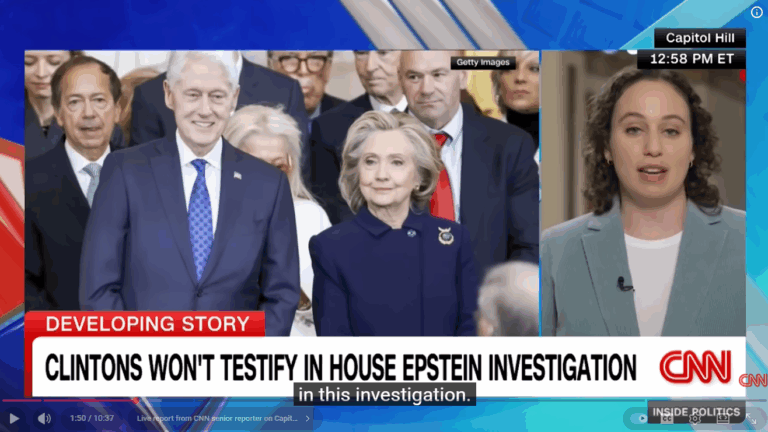
The phrase Clinton contempt proceedings may sound like political theater, but for many Americans, it lands with a heavier thud. When high-profile legal battles dominate headlines, they do more than shape news cycles. They shape public trust, stress levels, and confidence in the systems meant to protect fairness and accountability.
This week, those stakes grew higher after House Oversight Committee leaders announced they will move forward with contempt of Congress charges against former President Bill Clinton and former Secretary of State Hillary Clinton. The decision follows Hillary Clinton’s failure to appear for a deposition connected to the committee’s probe into Jeffrey Epstein, and Bill Clinton’s earlier refusal to testify.
What happens next could have legal consequences. But it also raises broader questions about civic stability, public confidence, and the emotional toll that prolonged political conflict can take on communities.
Why Contempt Proceedings Are Moving Forward
Republican Rep. James Comer, chair of the House Oversight Committee, said Wednesday that the panel will meet in a week to consider holding both Clintons in criminal contempt of Congress. If approved, the move would send the issue to the full House for a vote.
The committee issued subpoenas to the Clintons in August, seeking closed-door depositions as part of its Epstein investigation. According to Comer, committee staff spent months negotiating with the Clintons’ legal team to schedule appearances. When neither former president nor former secretary of state appeared this week, frustration boiled over.
“We’re going to hold both Clintons in criminal contempt of Congress,” Comer told reporters.
In his view, the issue is not just about compliance. It is about what he describes as a breakdown in cooperation after months of back-and-forth. “I think what’s most disappointing to the Oversight Committee is the fact that we have, in good faith, negotiated with the Clintons’ attorneys for five months,” Comer said.
Contempt of Congress is often misunderstood. It is not an automatic criminal conviction. Instead, it is a formal declaration that a person has refused to comply with lawful congressional demands. If the House votes to hold the Clintons in criminal contempt, the matter would be referred to the Department of Justice, which would then decide whether to pursue prosecution.
What the Clintons Are Arguing
The Clintons, for their part, say they are being treated unfairly.
In a series of letters to the committee, their legal team argued that the subpoenas are “invalid and legally unenforceable.” They also offered an alternative path forward, saying they would be willing to testify in a public hearing rather than in closed-door depositions.
Comer said that option is not off the table, but he questioned the sincerity of the offer. “That’s something we can talk about,” he said, adding that similar offers from other figures in past investigations never materialized.
The back-and-forth has turned procedural disputes into political flashpoints. Supporters of the committee argue that no one is above congressional oversight. Supporters of the Clintons counter that the investigation has crossed into selective enforcement.
For the public, the result is a familiar pattern: legal complexity layered on top of partisan tension, with few easy answers and plenty of noise.
What a Contempt Vote Could Actually Do
A successful contempt vote would be both symbolic and potentially consequential.
Symbolically, it would serve as a rebuke to two of the most prominent figures in modern American politics. Practically, it could be used to increase pressure on the Clintons to testify. If the matter reaches the Justice Department, federal prosecutors would have to decide whether the case warrants criminal charges.
That decision is not automatic, and history shows that contempt referrals do not always lead to prosecutions. Still, the possibility of legal escalation keeps the issue alive and amplifies its impact on public perception.
For many Americans, repeated clashes between lawmakers and public figures reinforce a sense that government is locked in perpetual conflict. Over time, that atmosphere can wear people down, making civic engagement feel exhausting rather than empowering.
Why This Matters for Public Trust and Civic Health
Although the story is rooted in politics and law, its ripple effects reach into the realm of public well-being.
High-profile investigations create a climate of uncertainty and tension. For some, that means anxiety about the stability of institutions. For others, it means frustration with what feels like endless political warfare. Either way, prolonged conflict at the national level often filters down into daily life, shaping conversations at work, at home, and online.
Public health experts have long noted that chronic stress, even when driven by news and social conditions, can affect how people feel, think, and engage with their communities. When trust in institutions erodes, people are less likely to believe that systems will work for them in moments of need, whether that involves legal protections, social services, or basic fairness.
That is why stories like this matter beyond their immediate legal scope. They influence how safe people feel in the broader civic environment. They shape whether citizens view accountability as real or performative. And they affect how willing people are to participate in public life at all.
In that sense, the Clinton contempt proceedings are not just about subpoenas and depositions. They are also about whether Americans feel their democracy is functioning with clarity and integrity.
What Happens Next
In the coming days, the House Oversight Committee will decide whether to advance the contempt charges. If the committee votes yes, the full House will then consider whether to hold both Clintons in criminal contempt of Congress.
From there, the Department of Justice would face a choice about prosecution, adding another layer of uncertainty to an already complex story.
For readers trying to make sense of it all, one thing is clear: moments like this test more than legal boundaries. They test patience, trust, and the public’s belief that accountability can exist without endless escalation.
In a time when many people already feel overwhelmed by political conflict, clarity matters. So does restraint. However this unfolds, the broader goal should be the same one most Americans share: a system that values transparency, fairness, and stability, not just headlines.





Call merger.\nWhy are they not in handcuffs right now
They want to testify in public so nothing is hidden or made up. The republicans want to hide everything.
Im not for protecting anyone related to Epstien in any way shape or form. If they are still talking and saying they want things to be Public, not behind closed doors, im all for it. Wouldn’t the proceedings just become part of the “Epstien Files” afterwards anyway?
The DOJ however was tasked with providing the entirety of the Epstien Files by December 19th. They released some and asked for. “Few more weeks” but as far as I know that is as far as it went. I have not heard anything else about it from them. We are currently at 4 weeks late.
In summary…
If you are not complying but negotiating trying to make things happen is contempt, but yet hiding things without communication issues not contempt i am very confused.
Release the Epstien files
Treat them as American citizens, not just as Bill and Hillary Clinton.
Treat them as American Citizens, not just as Bill & Hillary Clinton.
Nothing will happen again; they are powerful Democrats and get away with anything and everything
Republicans trying to turn all eyes on the Clinton’s to distract the epstien files on Trump they are desperate they know Donald Trump is all over them those aren’t redactions those are Trump and other important Republican names being blacked out