
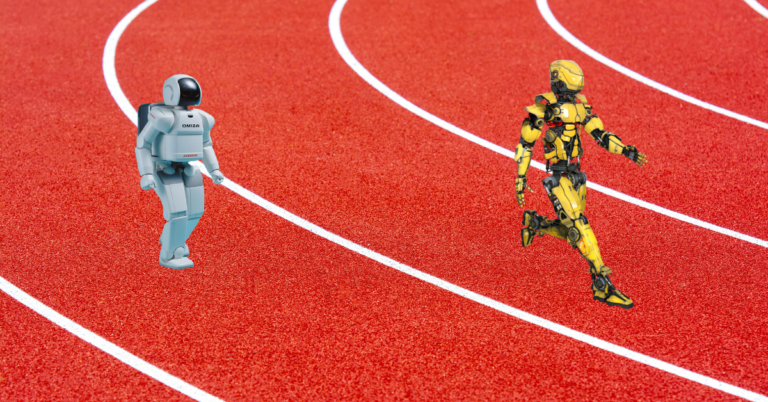
In a stunning leap forward, a machine didn’t just compete with elite runners, it left them behind. What comes next may matter far beyond the racecourse.
It started like any other race morning.
Cool air. Nervous energy. Thousands of runners gathered at the starting line, each carrying their own quiet ambition—to finish, to compete, maybe even to win.
But this race was different.
Because somewhere among the competitors stood a runner that didn’t breathe, didn’t tire, and didn’t feel pain.
And by the time it crossed the finish line, it had done something no human ever had.
It didn’t just win.
It rewrote what winning means.
The Race That Changed the Conversation
At the Beijing E-Town Half Marathon, a humanoid robot known as “Lightning” delivered a performance that has quickly become one of the most talked-about moments in modern technology.
Its time: 50 minutes, 26 seconds.
That’s not just fast—it’s historic. Faster than the human world record. Faster than the best distance runners on the planet.
For context, elite human runners train for years—often decades—to shave seconds off their times. Records fall slowly, sometimes standing for years before being broken.
This one didn’t fall.
It was obliterated.
Not Just Speed, A Different Kind of Athlete
Lightning didn’t surge at the end. It didn’t struggle on hills. It didn’t slow when fatigue would normally set in.
Because fatigue never came.
The robot ran autonomously, navigating the course without direct human control. No coach shouting splits. No instinct to rely on. Just sensors, algorithms, and precise mechanical execution.
And while human runners paced themselves carefully, balancing energy and endurance, Lightning simply… executed.
Perfectly.
That’s the real story here.
This wasn’t just a faster runner.
It was a fundamentally different kind of competitor.
The Fine Print That Matters
Before we declare the end of human athletic dominance, it’s worth understanding the full picture.
Robots and human runners weren’t shoulder-to-shoulder in a traditional race environment. Safety required separation. Conditions were optimized for machine performance. And while Lightning succeeded, other robots reportedly stumbled—some fell, others required assistance.
In other words, this wasn’t yet a clean, apples-to-apples competition.
But dismissing it would be a mistake.
Because progress like this doesn’t move backward.
From Curiosity to Capability, Fast
What makes this moment especially striking is how quickly it arrived.
Not long ago, robots attempting similar races were slow, unstable, and largely experimental—taking hours to complete distances that humans could cover far more efficiently.
Now?
They’re not just finishing.
They’re dominating.
That kind of acceleration tells us something important: we’re no longer watching early-stage experimentation. We’re watching refinement. Optimization. Real-world capability.
And that changes the stakes.
Beyond the Finish Line
It’s easy to frame this as a novelty story—a robot wins a race, the crowd reacts, the internet buzzes, and we move on.
But that misses the bigger picture.
Because the same advancements that allow a robot to run efficiently over 13.1 miles have implications far beyond sport.
- Machines that can operate longer than humans without fatigue
- Systems that adapt in real time to changing terrain
- Autonomous movement that requires no direct oversight
These are building blocks for industries already being reshaped—logistics, manufacturing, emergency response, even healthcare.
The race, in a sense, is just a demonstration.
The real applications are already lining up.
The Human Question
Moments like this tend to spark a familiar reaction:
What happens when machines surpass us?
It’s a fair question—but maybe not the most useful one.
Because in truth, machines have been surpassing human capabilities for decades. They calculate faster. Lift more. Process information at scales we can’t approach.
What’s different now is visibility.
Running is human. It’s primal. It’s something we understand instinctively.
So when a machine excels here, it feels personal.
Where This Is Headed
If this pace of advancement continues—and there’s little reason to believe it won’t—the gap between human and machine performance in physical tasks will only widen.
Not overnight. Not universally.
But steadily.
And that raises a more practical question:
How do we adapt?
Because the future likely isn’t humans versus machines.
It’s humans working alongside systems that are faster, more consistent, and increasingly autonomous.
Closing Thought
On that race day, thousands of runners crossed the finish line with the same sense of accomplishment people have felt for generations.
They pushed themselves. They endured. They finished.
That hasn’t changed.
What has changed is this:
For the first time, the fastest competitor on the course didn’t have a heartbeat.
And whether that feels exciting or unsettling may depend on what you think comes next.