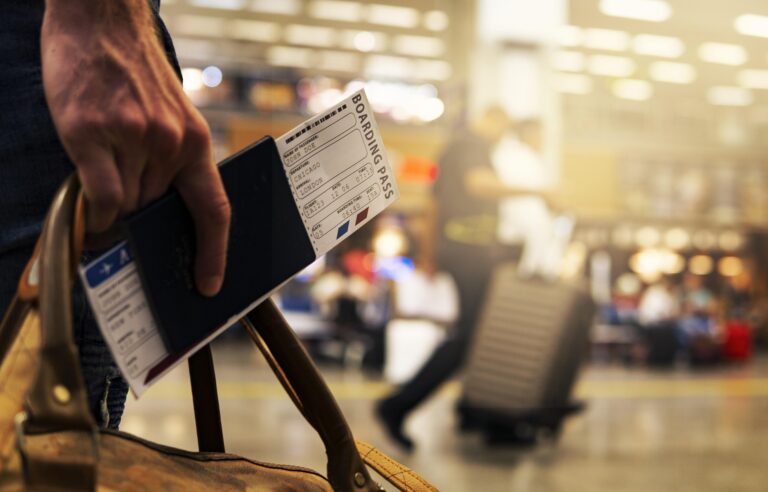
As the partial government shutdown stretches deeper into its fifth week, the ripple effects are no longer confined to Washington. They are playing out in real time at airport security checkpoints across the country—where long lines, staffing shortages, and rising traveler anxiety have become the new normal.
Now, a controversial decision by the Trump administration is adding a new and unexpected layer to the situation: the deployment of immigration agents inside U.S. airports.
At first glance, it sounds like a temporary fix to a logistical problem. But the reality is more complicated—and far more politically charged.
A Workforce Without Pay
At the center of the crisis is the Transportation Security Administration.
More than 50,000 TSA officers have been working without pay since the shutdown began, caught in a political standoff over federal funding. While they are considered “essential” employees and required to report to work, the financial strain is beginning to show in ways that directly impact travelers.
Absentee rates have surged.
Some officers are calling out sick. Others are leaving the job entirely, unable to sustain weeks without a paycheck. For many, the cost of commuting, childcare, and basic living expenses has become too much to carry without income.
The result is a system under visible strain.
At major airports, security lines have stretched well beyond normal wait times. Travelers are being advised to arrive hours earlier than usual, only to find crowded terminals and limited staffing on the other side of the checkpoint.
This is not a theoretical disruption—it’s happening at scale, during one of the busiest travel periods of the year.
Enter ICE
To address the growing staffing crisis, the administration has turned to another federal agency: U.S. Immigration and Customs Enforcement.
ICE agents have now been deployed to assist at several major airports across the country, including high-traffic hubs where TSA shortages have been most acute.
According to federal officials, their role is limited.
They are not replacing TSA officers, nor are they conducting passenger screenings. Instead, ICE agents are being used to support operations—helping manage crowds, monitor lines, and free up trained TSA personnel to focus on security procedures.
On paper, it’s a logistical solution.
But in practice, the presence of immigration enforcement agents in airport security areas has raised immediate questions.
The Line Between Support and Enforcement
The administration has been careful to frame this as a support mission. But the distinction between “support” and “enforcement” isn’t always clear—especially to travelers.
President Donald Trump acknowledged that while ICE agents are not specifically assigned to conduct immigration enforcement in this role, they retain full authority to act if situations arise.
That nuance matters.
It means that while travelers moving through security are unlikely to encounter direct enforcement activity, the possibility is not entirely off the table.
For some passengers, that creates uncertainty.
For others, particularly immigrant communities or mixed-status families, it introduces a layer of concern that extends beyond missed flights or long lines.
Critics Raise Concerns
The move has drawn swift criticism from labor groups, aviation experts, and lawmakers.
Opponents argue that ICE agents are not trained for aviation security environments, and that inserting them into airport operations—even in a limited role—could create confusion or unintended consequences.
There are also concerns about messaging.
Airports have long been seen as controlled, predictable environments. Introducing a visible law enforcement presence with a different mandate risks blurring the lines of authority and purpose.
Critics also point to the broader context: this is a temporary workaround for a problem that has a clear root cause—funding.
Rather than resolving the shutdown and restoring pay to TSA workers, the government is redistributing personnel from other agencies to fill the gaps.
That approach may stabilize operations in the short term, but it does little to address the underlying issue.
A System Near Its Breaking Point
Meanwhile, the numbers tell a concerning story.
Absentee rates among TSA officers have climbed to some of the highest levels on record. Hundreds of agents have already resigned, and more are expected to follow if the shutdown continues.
The timing could not be worse.
Spring break travel is ramping up, bringing a surge of passengers into already strained airports. Larger hubs may be able to absorb some of the pressure, but smaller regional airports are more vulnerable.
Federal officials have warned that without adequate staffing, some smaller airports could face partial shutdowns—an outcome that would ripple through local economies and disrupt travel on a much wider scale.
For travelers, the impact is immediate and tangible:
- Longer wait times
- Increased stress and uncertainty
- Greater risk of delays and missed flights
For workers, it’s even more personal.
Behind every statistic is a TSA officer showing up to work without knowing when their next paycheck will arrive.
The Bigger Picture
What’s happening in America’s airports right now is about more than travel delays.
It’s a case study in how political gridlock can cascade into everyday life—affecting not just government workers, but millions of ordinary people trying to get from one place to another.
The deployment of ICE agents may help ease some of the immediate pressure. But it also highlights how far the system has been stretched.
Roles are shifting. Expectations are changing. And the line between temporary solutions and long-term consequences is becoming harder to see.
For now, travelers are left navigating a system that feels increasingly unpredictable.
And until the underlying funding crisis is resolved, there’s no clear end in sight.