
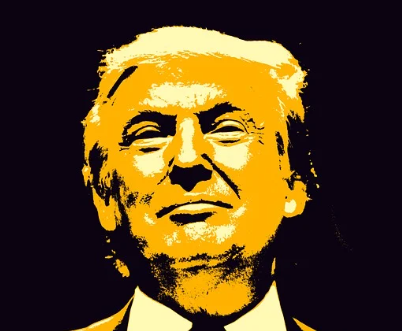
It began, as many modern political controversies do, with a post.
By Sunday evening, President Donald Trump had turned his attention toward one of the most unexpected adversaries of his second term: Pope Leo XIV. What followed over the next 24 hours was not just another political spat, but a revealing case study in how social media continues to shape, and at times destabilize, the highest levels of power.
A Public Break with the Vatican
The conflict had been building.
Pope Leo XIV, the first American-born pontiff, had emerged as a vocal critic of U.S. foreign policy, particularly the escalating conflict involving Iran. In recent days, he condemned what he described as a global “idolatry of power” and warned against the moral consequences of war.
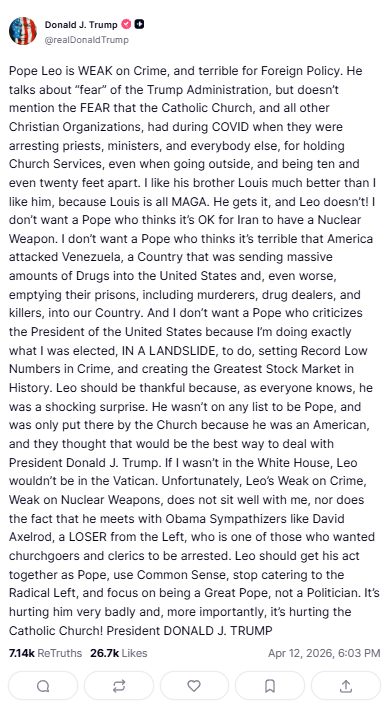
Trump responded not through diplomatic channels, but directly to his audience.
In a lengthy social media post, he accused the Pope of being “weak on crime” and “terrible for foreign policy,” framing the religious leader not as a moral authority, but as a political opponent.
The tone was familiar. The target was not.
For decades, American presidents, regardless of party, have treated the papacy with a degree of deference. Trump’s decision to engage in open, personal criticism marked a notable departure, even by his own standards.
The Image That Crossed a Line
Then came the image.
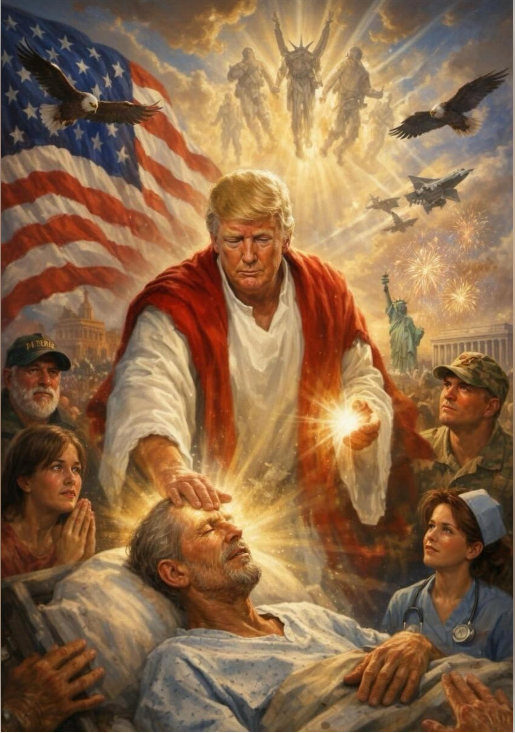
Late Sunday into Monday, Trump shared an AI-generated picture of himself depicted in a Christ-like role—draped in robes, extending a hand in what appeared to be a healing gesture. The imagery was unmistakable.
Within hours, backlash spread across political and religious lines.
Even some of Trump’s traditional allies, particularly among Christian conservatives, called the image inappropriate, with critics labeling it blasphemous and disrespectful.
The post remained live for roughly half a day before being deleted Monday afternoon.
By then, the damage was done.
Explanation—or Deflection?
When asked about the image, Trump offered a striking explanation: he believed it depicted him not as a religious figure, but as a doctor, possibly associated with humanitarian work.
The response did little to quiet the controversy.
Observers noted that the symbolism: familiar robes, lighting, physical posture, all closely mirrored traditional depictions of Jesus. The explanation, to critics, felt less like clarification and more like an attempt to reframe intent after the fact.
And notably, Trump declined to apologize.
A Pattern, Not an Outlier
To view the weekend in isolation would miss the larger story.
Trump’s social media presence has long been a defining feature of his political identity. He’s direct, unfiltered, and often confrontational. But recent months have shown an escalation in both tone and content.
Earlier in April, he posted threats related to Iranian infrastructure. Weeks before that, he amplified controversial and offensive imagery involving political opponents.
The throughline is not just provocation, it’s persistence.
Each incident follows a familiar arc: a post, immediate backlash, partial retraction or explanation, and then a rapid shift to the next controversy.
The Risk Calculation
The political question now is not whether the posts were controversial, but whether they matter.
Trump has historically maintained strong support among religious voters, particularly evangelical Christians and conservative Catholics. This moment, however, introduces a more complicated dynamic.
Criticism of the Pope is one thing.
An image perceived as placing oneself in a Christ-like role is another.
Early reactions suggest discomfort even within traditionally supportive circles. Whether that translates into measurable political consequences remains unclear, but the tension is real.
The Bigger Shift
What this weekend ultimately reveals is a broader transformation in presidential communication.
Social media is no longer just a tool of messaging. It has become a stage for conflict, identity, and spectacle—often blurring the line between governance and performance.
And in that environment, the post is no longer just a post.
It is policy-adjacent. Diplomacy-adjacent. Power-adjacent.
For Trump, that approach has always been central to his appeal.
But as this weekend demonstrated, it also carries risks. Especially when the audience extends beyond supporters to include institutions as enduring, and as sensitive, as the global Church.
The Bottom Line
A feud with a pope.
An image that sparked accusations of blasphemy.
And a deletion that came just late enough to ensure maximum impact.
In another era, this might have been a diplomatic incident handled behind closed doors.
In 2026, it unfolded in real time—scroll by scroll, post by post, leaving behind a question that continues to follow this presidency:
Where is the line between communication and controversy?
And how many times can it be crossed before it starts to matter?






Why don’t you follow your own advice and do your job and keep your nose to the “grindstone” and out of EVERY OTHER JOB IN THE U.S.OF A. Plus, no one else will ever confuse your image with that of JESUS CHRIST.