
President Donald Trump has issued a series of increasingly stark and, at times, incendiary warnings toward Iran—culminating in a self-imposed deadline that has pushed tensions to the brink and drawn global concern over both policy and tone.
At the center of it all is what officials and analysts are now calling the Trump Iran deadline: a demand that Iran reopen the Strait of Hormuz and agree to U.S. terms—or face what the president himself has described in catastrophic terms.
“A whole civilization will die tonight,” Trump wrote, in a statement widely reported and confirmed across outlets including Reuters.
It was not a one-off remark.
A Pattern of Escalating, Unfiltered Threats
In the days leading up to the deadline, Trump has used speeches, interviews, and especially social media to deliver a barrage of warnings—many of them focused not just on military action, but on total destruction of infrastructure and regime change.
According to Associated Press reporting, Trump has repeatedly threatened to strike Iranian power plants, bridges, and energy facilities if Iran fails to comply.
Those are not symbolic targets.
They are the backbone of civilian life.
Legal experts and lawmakers have responded sharply. As reported by The Guardian, critics described the rhetoric as potentially amounting to threats of war crimes, given the implications of targeting infrastructure essential to civilian survival.
Trump has dismissed those concerns.
The Strait of Hormuz: A Global Pressure Point
The Trump Iran deadline centers on one of the most strategically critical waterways in the world: the Strait of Hormuz.
Roughly 20% of global oil supply passes through this narrow corridor.
Iran’s disruption of shipping there has already sent shockwaves through global markets and triggered military responses. U.S. and allied strikes have targeted Iranian infrastructure, while Iran has retaliated against regional energy assets.
Against that backdrop, Trump’s deadline is not just diplomatic—it is tied directly to global energy stability and military escalation.
“Open the Strait”—and the Tone That Followed
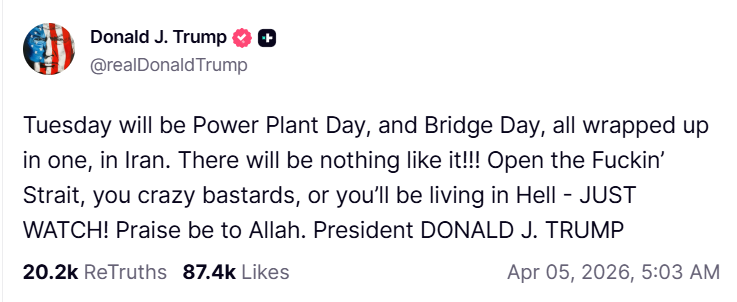
Some of Trump’s most controversial language has come through social media posts tied to the crisis.
Multiple outlets, including New York Post and other media reports, have documented posts in which Trump used profane and unusually informal language, demanding Iran reopen the strait and warning of devastating consequences.
While not all circulating quotes have been independently verified by major outlets, the pattern is clear:
- Repeated ultimatums
- Increasingly aggressive phrasing
- References to large-scale destruction
- Public discussion of specific infrastructure targets
This is not traditional diplomatic signaling.
Deadline Diplomacy—or Something Else?
The Trump Iran deadline itself has shifted repeatedly.
According to Associated Press, the president has issued multiple deadlines, extending or revising them as negotiations stalled.
Now, he insists the latest deadline is final.
That inconsistency is part of the story.
Supporters argue it reflects negotiation strategy—apply pressure, adjust, push again.
Critics see something more concerning: a pattern of escalation without a clearly defined endgame.
Global Reaction: Alarm and Uncertainty
International reaction has been swift and uneasy.
European leaders have called for de-escalation. Regional governments are preparing for potential spillover. Markets are reacting to each new development.
And analysts are focusing on one factor above all: the rhetoric itself.
When a sitting president warns of the destruction of an entire civilization, it changes the stakes—not just politically, but operationally.
As Reuters reported, the language has been interpreted by some experts as crossing into territory rarely seen in modern statecraft.
The Risk of Miscalculation
The danger in moments like this is not just action—it is interpretation.
If Iran views the Trump Iran deadline as signaling imminent, large-scale attack, it may respond preemptively.
If allies view the rhetoric as unpredictable, coordination may weaken.
And if adversaries misread intent, escalation can accelerate faster than diplomacy can contain it.
This is the paradox of high-intensity rhetoric: it is designed to create leverage—but it can also create instability.
Inside Washington: Divided Reactions
In Washington, reaction has been sharply divided.
Some officials defend the president’s approach as necessary pressure in a high-stakes conflict.
Others, including lawmakers cited in The Guardian, have gone further—raising concerns about legality, judgment, and the potential consequences of targeting civilian infrastructure.
At the same time, the administration has provided limited clarity about what exactly happens if the deadline is not met.
That gap—between rhetoric and defined policy—is where much of the uncertainty lives.
A Defining Moment
The Trump Iran deadline is not just another foreign policy episode.
It is a moment where:
- Presidential rhetoric is unusually direct and public
- Military threats are explicitly tied to civilian infrastructure
- Global markets and governments are reacting in real time
And where the difference between signal and action is not entirely clear.